Kimberly
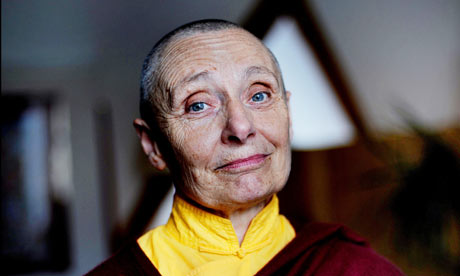
Michelle Johnson, who teaches meditation at the Washtenaw Community
College Health and Fitness Center, says improved health is a major
benefit of meditation. Photo courtesy of Laura G. Hart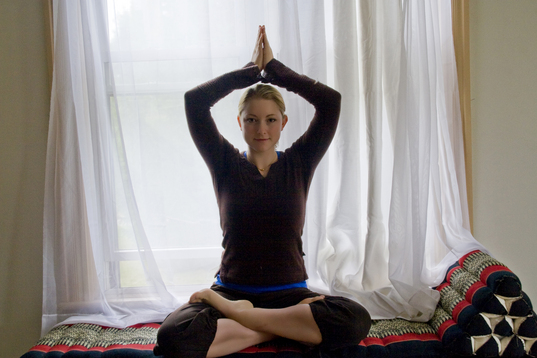
Quakers, Buddhists, agnostics, Hindus - they’re all doing it. Over the last few decades, meditation has evolved from a fringe practice to a mainstream stress-reduction technique that might be recommended by your family doctor.
In Washtenaw County, you have your choice of a wide variety of meditation classes and settings, ranging from the Zen Buddhist Temple in Ann Arbor, to a Quaker center in Chelsea to the Washtenaw Community College Health and Fitness Center.
Nationally, meditation is among top three alternative health methods used by Americans. According to a 2007 survey sponsored by the National Center for Complementary and Alternative Medicine (a division of the National Institutes of Health), more than 9 percent of Americans say they meditate. Only herbal supplements and deep-breathing exercises are more popular.
Meditation and health benefits
Carol Blotter, a meditation teacher based in Chelsea, brings to the practice both a Quaker perspective and training in techniques based in Eastern spirituality. She has led meditation workshops and retreats at the Michigan Friends Center in Chelsea and at Deep Spring Center in Ann Arbor.
Blotter pointed to author and researcher Jon Kabat-Zinn as a pivotal figure in the mainstreaming of meditation. Kabat-Zinn is the founder of the Center for Mindfulness in Medicine, Health Care, and Society at the University of Massachusetts Medical School.
Blotter noted that other scientists had studied meditation, but added, “Zinn really packaged it up… Americans like something with scientific approval.”
“He created a program called mindfulness-based stress reduction,” she said. “And you’ll find it in an awful lot of hospitals these days. Statistically, it’s phenomenal the impact meditation and mindfulness have on an individual’s health.”
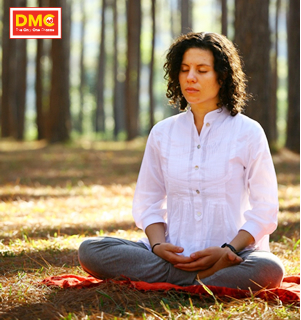
Kimberly Michelle Johnson has been teaching meditation at the Washtenaw Community College Health and Fitness center for about a year. Johnson also mentioned improvements in health as a major benefit of meditation.
“Stress reduction has such a big impact on overall health,” she said. “It can aid in lowering blood pressure, assist in chronic pain reduction and help to relieve insomnia.”
The Ann Arbor Zen Buddhist Temple typically attracts up to 50 area residents for meditation meetings on Sunday mornings and as many as 30 on Sunday afternoons, according to the Rev. Haju Sunim (Linda Murray), resident priest.
Haju Sunim, who helped found the local Buddhist temple in 1982, said she sees modern students use meditation as a way to survive the stresses of everyday life rather than as a route to enlightenment. She said that even with that more secular aim, meditation has benefits.
“It can be very helpful as people learn to pay attention to the myriad of things that arise in their body and mind,” she said. “People often judge themselves and say they’re no good at meditation because so many thoughts are coming up, and they can’t calm their minds. My response is that it’s part of the process. Meditation is something that allows us to see and then to work with what comes up.”
Meditation as spiritual practice
Johnson’s Thursday night classes are designed to be accessible to students from a variety of backgrounds. Participants scan the body for areas of discomfort and pay careful attention to deep breathing.
“The meditation and relaxation techniques can be helpful no matter what your religious or spiritual tradition,” Johnson said. “Students are welcome to tailor the practice to incorporate their personal spiritual beliefs.”
For example, she said, the students can express their spirituality through their choice of mantra. The mantra could be an Eastern-style “Ohm,” a Christian phrase like “God is love” or simply “Let go.”
Blotter said that what people get out of meditation depends on their motivations.
“The wording, the practices that are used and the intention are all different because there are so many different kind of people in this world,” she said.
For many who are just discovering meditation, Blotter said, the emphasis is on feeling better immediately. However, for some, meditation might morph into a more spiritual practice over time.
“The modalities of meditation really expand along that whole continuum from ‘just give me something to do to make me feel better in this moment’ to ‘help me live my life with more honesty, clarity and openness from the heart.’ Many people start with the motivation to ‘just fix this one thing right now,’ and, over time, it changes into an awareness of a spiritual nature.”
In September, Blotter helped run a fall weekend meditation retreat at the Michigan Friends Center. Blotter compared the fall retreat to polishing silver and taking away all the tarnish that can build up after time.
“They can relax into nature, relax into spirit, have time to take a breath.”
Haju Sunim said that, in a Buddhist context, meditation is much more than a coping strategy.
“We’re not meditating for the sake of meditating; we’re meditating to have some deep understanding of life and death,” she said.
She said that meditating in the Zen Buddhist Temple is qualitatively different than taking a college course or a meditation class at a recreation center.
“Something very precious about our particular place is that it is a residential temple,” she said. “Residents… keep a schedule in the mornings and evenings so members can come in and practice if they want to.”
She said that in Asia, village life is affected by proximity to Buddhist temples, where morning prayers and bells rung for evening services set the rhythm of life. She said she hopes that the Ann Arbor Temple has a similar influence on its neighbors.