This sort of view advocates any form of practice which praises pr honours the virtues of others. To give some examples:
He has many worldly experiences in his life and has seen many kinds of people from every class. Being a Dream in Dream kindergarten student, he realized that “merit” makes people different. What merit makes a normal person be a president, a prime minister, and some become ministers or less powerful leaders, respectively? If one wishes to be a leader like this in every life, what can he do?
He grew up in a perfect family. He was taught to have discipline and moral principles. He quite succeeded in his study and career. His life went into a politics and got many important positions in politics, such as minister in the prime minister’s office. People respected him as a “political advisor”
In 1999, statistics in Thailand showed that the number of elderly people who are being neglected increased by at least 300,000 per year while retirement homes in Thailand can only accommodate an increase of 200 people per year
The 38 Ways to Happiness. The Sixth Group of Blessings. Blessing Twenty:- Restraint from Drinking Intoxicants.
I pay homage to the Buddha, the Dhamma, the Sangha, and the great teachers who have imparted upon me the Dhammakaya Knowledge.
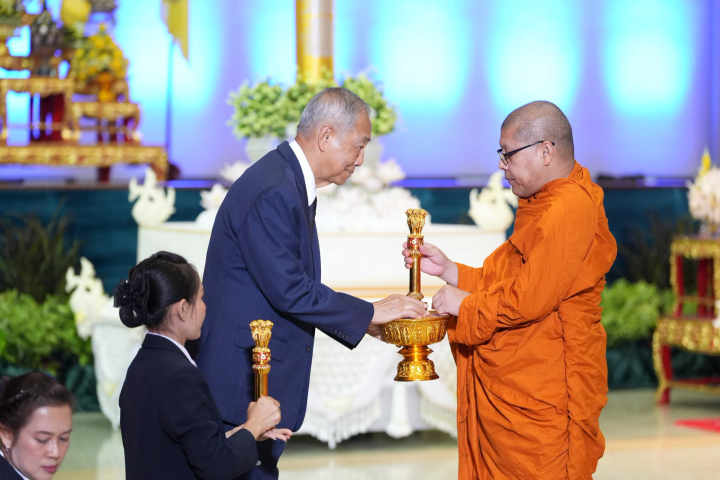
The Ashoka Pillar Award recognizes moral leaders in Buddhism, presented by the Association of Buddhist Benefactors in Thailand, honoring 186 awardees for their contributions to morality and society.
Body like a doormat means dedication all of one’s energy and dedicating one’s life to performing good deeds with virtuous actions
I’d like to ask you about an old tradition of Thai society that urges children to prostrate themselves at their parents’ feet before going to bed. How does this tradition help develop children’s virtue? If the people of the present time would like to reintroduce that tradition, where can they begin?
We do not search for these and do not wish to encounter them. Even when they have not arrived, we are afraid that they will soon arrive