

FU : ค้นหาหนังสือธรรมะ หน้า 57 / 107
หน้าหนังสือทั้งหมด
34
Understanding Dhammakāya in Early Buddhist Thought
…id to say that the teaching taught and the discipline laid down by him (dhamma-vinaya) would be the future teacher after his passing. The third is the Buddha’s discourse delivered to the elder Vakkali w…
The term 'dhammakāya' in the Pali canon is understood as representing the Buddha's teachings. It is established through several canonical passages that equate the Buddha with dhamma. Notable reference
38
Understanding the Concept of Dhammakāya in Buddhist Thought
D.III.84
Vāsettha and Bhāradvāja, he whose confidence in the
Tathāgata is settled, rooted, established, solid, irremovable by
any ascetic or brahmin, any deva or Māra or Brahmā or anyone
in the world
…mpounds that describe the Tathāgata and the varying scholarly interpretations surrounding them. For further information, visit dmc.tv.
39
Interpretations of Dhammakāya in Early Pāli Texts
…r context it is clear that dhammakāya is being identified with the scriptural legacy.
31 He notes further that, even though the term has encountered a series of changes of meanings in the Pāli comment…
This text delves into various scholars' interpretations of the term 'dhammakāya' within the context of early Pāli suttas. Gombrich views it as 'dhamma-bodied,' emphasizing that the essence of the Budd
43
Understanding the Noble Discipleship in Buddhism
…eam’ of the Holy Eightfold Path (S.v347) and is endowed with ‘unwavering confidence’ in the three refuges: the Buddha, Dhamma and the Holy Sangha of Stream-enterers and other saints (S.II.68).”
…ng their state aids in recognizing genuine practitioners of Buddhism, as opposed to mere claimants. Further analysis is given on the role of saddhā in distinguishing a person’s spiritual stature. Visit …
45
Understanding Dhamma and Spiritual Realization
… qualities.
The titles ‘born of dhamma’ (dhammaja) and ‘created by dhamma’ (dhamma-nimmita) imply a further step - the realization or attainment of dhamma, and the consequent transformation of the perso…
This content discusses the process of spiritual attainment through dhamma, emphasizing four key activities that lead to the emergence of noble qualities. It highlights how listening to the Buddha's te

47
Implications of Parallel Descriptions of Monks and Brahmins
Implications of Parallel Descriptions of Monks and Brahmins
As Gombrich points out, the passage in question is comparable to the Brahmins’ claim:46
brahmanā va brahmuo putṭā orasā mukhato jāta brahma
…ead to varying interpretations that affect the understanding of their theological implications. For further analysis, visit dmc.tv.
48
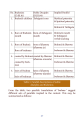
Brahmins and Noble Disciples: A Comparative Analysis
No. | Brahmins (D.III.81) | Noble Disciples (D.III.84) | Implied Parallel
---|------------------------|---------------------------|------------------------
1. | Brahma's children | Tathägata's sons |
…oth are seen as offsprings of divine origins—Brahma for Brahmins and Tathägata for Noble Disciples. Furthermore, the discussion emphasizes their teachings, with Brahmins associated with verbal teachings…
51
The Transformative Power of the Noble Eightfold Path in Buddhism
…with both of them.
In this regard, the Patisambhidāmagga describes that the four transcendent paths function in eradicating different sorts of defilements53. Once a particular 'transcendental path' (lok…
This text delves into the concept of transformation in Buddhist philosophy, specifically through the Noble Eightfold Path. It highlights how this path aids in the eradication of defilements, enabling
57
The Concept of Dhamma and Kāya in Buddhist Philosophy
…ts both their similarities and differences which may be considered in two aspects: ‘structure’ and ‘function.’
Structurally, both ‘body’ and ‘collection’ consist of a number of elements or individual …
…alyzes the term kāya, translated as either ‘body’ or ‘collection,’ emphasizing their structural and functional similarities and differences. Both terms encapsulate a collection of individual elements, e…
59
Understanding Dhamma and Nibbāna
The parallel usage of dhammakāya and dhammabhūta with brahmakāya and brahmmabhūta suggests further that the term dhamma in the passage should refer to Nibbāna. Indeed, it is possible also to sa…
This study delves into the concepts of dhamma and Nibbāna, positing that dhamma refers to transcendental dhamma, which serves as a transformer and defilement eradicator. It explores how the realizatio
60
Understanding Dhammakāya: The Essence of Transcendental Dhamma
… the path-constituents but the ‘essential totality’ by which a ‘body’ is defined.
The dependence of functions of individual constituents on the ‘totality’ of the particular transcendental path allows it…
This text discusses the concept of Arhatship and the definition of Dhammakāya in the context of Buddhist philosophy. It argues that the path should be seen as an essential totality, forming a 'body,'
63
Understanding Paccekabuddhas in Buddhist Philosophy
… agreeable to the audience, the Buddha would not speak it.
3. Knowing what is true, correct, and useful, whether or not it will be dear or agreeable to the audience, the Buddha would know the right time…
…istinct school but as a practice for spiritual realization. The Buddha's criteria for speaking truthfully aim to benefit listeners. The categorization of Paccekabuddhas as 'Buddhist' or 'non-Buddhist' m…
64
Understanding Paccekabuddhas in Buddhism
91 While it is possible for a Paccekabuddha to teach an individual which finally leads to that person's enlightenment, he does not teach to a multitude of people in the same way as a Buddha does. Henc
… the unique attributes and contributions of Paccekabuddhas within the broader Buddhist context. For further details, visit dmc.tv.
65
The Characteristics of Paccekabuddhas in Apadāna Literature
…ifying 'Paccekabuddhas' To consider what is meant by the term dhamma(s) in this compound, it is helpful to look at the preceding verses of the same story.
Immediately preceding the verse in question, …
…Verse 52 describes them as having great dhammas, being free from suffering, and possessing a delightful mind. The preceding verses further elaborate on their purity of virtue and wisdom, their composed …
66
Understanding Paccekabuddhas: Characteristics and Dhamma
These verses describe the Paccekabuddhas as ones possessed of supreme purity, wisdom, wakefulness, composure, and having the ability for seeing and knowing. In other words, they are full of re…
These verses highlight the qualities of Paccekabuddhas, emphasizing their supreme purity, wisdom, and self-enlightenment capacity. The term ‘mahatadhamma’ refers to the great dhammas that relate to th
69
The Superiority of Dhamma over Worldly Existence
…ld relieve thirst (only) momentarily; But I was fed by you the dhamma-milk that is perpetually peaceful. In this passage, a comparison is made between worldly motherhood and spiritual paternity, the fos…
ในบทความนี้เสนอการเปรียบเทียบระหว่างความเป็นแม่ในโลกกับการเป็นบิดาทางจิตวิญญาณ โดยเน้นที่การดูแลร่างกายทางกายภาพและร่างกายทางจิตวิญญาณ รวมถึงประสิทธิภาพในการบรรเทาความกระหายของนมธรรมดาและนมที่เป็น dha
70
The Essence of Dhamma-Milk in Spiritual Growth
… sounds likely that such ‘milk’ refers to his ‘teaching.’ However, its quality as ‘unceasingly peaceful’ indicates the state to which the teaching has brought her. That is to say, she is led from the in…
…gned with spiritual wisdom. The insights underscore the importance of dhamma-milk in achieving true fulfillment and happiness through understanding and experience.
73
Supramundane Paths and Fruits in Dhammakāya
… levels of noble persons. As far as a person is still a trainee (sekha-puggala), he/she still needs further development. Once he/she has attained the eighth state - the state of a non-trainee (asekha-pu…
…nd to qualities of trainees, whereas the eighth signifies the attainment of an Arhat, indicating no further growth is necessary. The term ‘dhammakāya’ is closely linked with the concepts of Nibbāna and …
74
Understanding Dhammakāya and Enlightenment
the function of each particular transcendent dhamma.116 The totality of transcendental qualities constitut…
…ing how the abandonment of defilements leads to a profound sense of release and knowledge. The text further clarifies the different levels of dhammakāya, suggesting that each level corresponds to varyin…
76
Understanding the Terms Kevala and Dhammakāya in Buddhist Texts
…ticiple dipenta, are written in the same case, i.e., accusative. This allows the term dhammakāya to function either as the subject or object of dipenta. In the former case, the term dhammakāya functions…
…. The syntax of these verses allows for various translations and interpretations, with 'dhammakāya' functioning as both subject and object in specific contexts, raising discussions around the teachings …