

C : ค้นหาหนังสือธรรมะ หน้า 296 / 507
หน้าหนังสือทั้งหมด
64
Understanding Paccekabuddhas in Buddhism
91 While it is possible for a Paccekabuddha to teach an individual which finally leads to that person's enlightenment, he does not te…
The text discusses the distinct nature of Paccekabuddhas, who can guide individuals toward enlightenment but do n…
65
The Characteristics of Paccekabuddhas in Apadāna Literature
In the Apadāna literature, besides the life history of the Buddha and his disciples, a section is devoted to a depiction of the characteristics of Paccekabuddhas. This - section …
The Apadāna literature highlights the characteristics of Paccekabuddhas, emphasizing their significant dhammas and independent mind. Verse …
66
Understanding Paccekabuddhas: Characteristics and Dhamma
These verses describe the Paccekabuddhas as ones possessed of supreme purity, wisdom, wakefulness, composure, and hav…
These verses highlight the qualities of Paccekabuddhas, emphasizing their supreme purity, wisdom, and self-enlightenment capacity. The term ‘ma…
68
Dhammakāya and Noble Disciples
VI. Reference 3: Dhammakāya and Noble Disciples
Besides the term’s relation to the Buddha and Paccekabuddhas, a …
In the context of Pāli texts, the term dhammakāya is linked to noble disciples as evidenced in the story of …
70
The Essence of Dhamma-Milk in Spiritual Growth
…oned in the previous verse.
In verse 33, Gotami is said to have been fed on the ‘dhamma-milk.’105 Because it is fed to her by the Buddha, it sounds likely that such ‘milk’ refers to his ‘teaching.’ How…
The concept of dhamma-milk represents spiritual nourishment derived from the Buddha's teachings, leading …
72
Understanding the Levels of Dhammakāya and Noble Disciples
In regard to the different levels of dhammakāya, the canon talks about the different states of trainees (sekha) and non-trainees (asekha). The former refe…
The text elaborates on the different levels of dhammakāya, categorizing trainees and non-trainees based on their qualities and practices. Trainees are seen as i…
73
Supramundane Paths and Fruits in Dhammakāya
supramundane paths and fruits. 113 The ‘four pairs’ are mentioned instead when particular paths and their corresponding fruits are collectively called under the same titles. Of the eigh…
The text discusses the different transcendental levels of dhammakāya, highlighting the distinction between traine…
74
Understanding Dhammakāya and Enlightenment
the function of each particular transcendent dhamma.116 The totality of transcendental qualities constitutin…
This text analyses the concept of dhammakāya, highlighting its connection to enlightenment and the associated happiness. It …
75
Dhammakāya and the Previous Buddha
VII. Reference 4: Dhammakāya and Previous Buddha
Another Pāli passage that shows the relation of dhammakāya with …
บทความนี้วิเคราะห์ความสัมพันธ์ของคำว่า Dhammakāya กับพระพุทธเจ้าในพระอัฏฐสังคษา โดยมีการเล่าถึงชีวิตของพระอรหันต์ Atthasandassaka ที่มีความคิดถึงพระพุทธเจ้า Padumuttara และการยกย่องพระพุทธเจ้าในบทกวีส
77
Re-evaluating the Concept of Dhammakāya in the Pali Canon
No-one can upset the (Padumuttara Buddhu) entire mine of jewels, who is demonstrating the dhammakāya; having…
This study revisits the term dhammakāya in the Pali canon, highlighting its significance in Buddhist teachings. By examining the Sambuddha-sutta, the rel…
80
Understanding Dhammakāya and its Significance in Buddhism
mental qualities128 or purity,129 or identifies it with realities to be
attained or experienced spiritually by noble disciples through the
penetration of the noble paths.130 In one instance, he…
This text examines the term dhammakāya as articulated by Buddhaghosa, linking it to spiritual realities and teachings of the Buddha. It highlights …
81
Understanding Dhammikāya in Buddhist Philosophy
…ha’s mental
qualities and purity,134 with the Enlightenment either of the Buddha135
or his noble disciples,136 with reality visible through the ‘seeing’
(dassana) of the noble truths137 or with ‘self.’…
Dhammapāla discusses dhammikāya, relating it to the Buddha's mental qualities and Enlightenment. This term connects…
82
Interpretations of Dhammakāya in Pali Commentaries
In addition to the above two commentators, Upasena and Buddhadatta141 are also Pali commentators who lived around the same times.1…
The text discusses the interpretations of the term 'dhammakāya' by various Pali commentators, focusing on Upasena…
83
Understanding Dhammakāya in Theravāda Buddhism
…few passages, however, Sāriputta also refers to the term dhammakāya in the sense of the Buddha’s teaching.150
On the whole, traditional Theravādins interpret the term dhammakāya mostly in the sense of…
This passage examines the term 'dhammakāya' as interpreted in traditional Theravāda Buddhism. It discusses the general view of dhammakāya as reflecting the qualities of the Buddha and the spiritual rea…
85
Academic Studies on Buddhism
Mus, Paul. Barabudur: Sketch of a History of Buddhism Based on Archaeological Criticism of the Texts. New Delhi: Indira Gandhi …
This collection features key academic contributions to the study of Buddhism, drawing from archaeological …
86
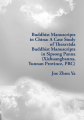
Buddhist Manuscripts in China: A Case Study of Theravāda Buddhist Manuscripts in Sipsong Panna (Xishuangbanna, Yunn…
87
Buddhist Manuscripts in China: Theravāda Buddhism in Sipsong Panna
Buddhist Manuscripts in China: A Case Study of Theravāda Buddhist Manuscripts in Sipsong Panna (Xishuangbanna, Yunn…
This article delves into the rich tapestry of Buddhist culture in China, specifically focusing on the Theravād…
88
Overview of Theravāda Buddhist Manuscripts in China
I will give a brief overview of the manuscripts that have been
discovered and catalogued, an explanation of some current research
projects, an…
This document provides an overview of Theravāda Buddhist manuscripts found in China, particularly in Yunnan …
89
Preservation of Dai Buddhist Manuscripts in Sipsong Panna
This project is in accordance with the national emphasis on the protection and development of religious culture…
This project aligns with the national focus on protecting religious culture in minority areas, specifically the…
91
Exploration of Theravāda Buddhist Manuscripts in Sipsong Panna
literature.9 It is notable that the Agama Sutras (阿含经) discovered in the Xishuangbanna region are incomplete. For example, the Hinayana Agama should have conta…
The Agama Sutras found in the Xishuangbanna region are notable for their incompleteness. The Hinayana Agama is expected to contain various texts that are partly missing. Accord…