

Pali : ค้นหาหนังสือธรรมะ หน้า 12 / 18
หน้าหนังสือทั้งหมด

31
Dhammakāya
in the Pali Canon¹
Chanida Jantrasisalai
38
Understanding the Concept of Dhammakāya in Buddhist Thought
D.III.84
Vāsettha and Bhāradvāja, he whose confidence in the
Tathāgata is settled, rooted, established, solid, irremovable by
any ascetic or brahmin, any deva or Māra or Brahmā or anyone
in the world
In this passage, Vāsettha and Bhāradvāja discuss the unwavering confidence in the Tathāgata, stating that those deeply rooted in dhamma can claim to be heirs of dhamma. The term 'dhammakāya' and its i
42
Saddhā: The Criterion of Being the Tathāgata's Son
…les ‘ascetic, brahmin,
god, Māra, and Brahma’ respectively.
According to Buddhist philosophy in the Pali canonical context,
this kind of unshakeable confidence is not merely a ‘strong belief’
or ‘firm fai…
This text discusses the criterion of being the Tathāgata's son, emphasizing the irremovable confidence (saddhā) in the Buddha. It defines this confidence as settled and unchangeable despite external i
43
Understanding the Noble Discipleship in Buddhism
Vin.II.192, A.IV.186, 210, 213
Just as a piece of clean cloth that is deprived of dirt would well-absorb the dye, the pure and clear eye of dhamma (dhammacakku) arose to the man, on that current seat
The text discusses the qualities of noble disciples in Buddhism, emphasizing the importance of clear perception of dhamma and the eradication of doubts and fetters. It describes the transformation exp
52
Understanding the Noble Eightfold Path and Threefold Path in Buddhism
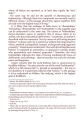
[Right concentration, again, becomes the basis of right views, right aspirations, and other steps of the noble eightfold path, which is now experienced on a higher level, and this spiral-like progress
This text elaborates on the interrelationship between Right Concentration, Right Views, and Right Aspirations as pivotal elements of the Noble Eightfold Path leading to liberation. It discusses the sp
56
Understanding Brahmabhūta and the Path to Nibbāna
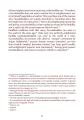
where all fetters are unrooted, or at least they signify the ‘best’ state.
The same may be said for the parallel of dhammacarĺa and brahmacarĺa. Although these two compounds are normally used in dif
The text discusses how 'brahmabhūta' refers to the state of having eradicated all defilements, allowing one to experience ultimate peace and happiness. It parallels 'dhammacarĺa' and 'brahmacarĺa' as
64
Understanding Paccekabuddhas in Buddhism
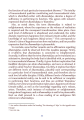
91 While it is possible for a Paccekabuddha to teach an individual which finally leads to that person's enlightenment, he does not teach to a multitude of people in the same way as a Buddha does. Henc
The text discusses the distinct nature of Paccekabuddhas, who can guide individuals toward enlightenment but do not teach the masses like Buddhas. Their teachings emphasize solitude and are succinct,
74
Understanding Dhammakāya and Enlightenment
the function of each particular transcendent dhamma.116 The totality of transcendental qualities constituting each transcendental state, which is identified earlier with dhammakāya, denotes a degree o
This text analyses the concept of dhammakāya, highlighting its connection to enlightenment and the associated happiness. It emphasizes the blameless nature of dhammakāya and notes Gotami's insights in
75
Dhammakāya and the Previous Buddha
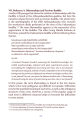
VII. Reference 4: Dhammakāya and Previous Buddha
Another Pāli passage that shows the relation of dhammakāya with the Buddha is found in the Atthasandassakathera-apadāna. But here the narrative relates
บทความนี้วิเคราะห์ความสัมพันธ์ของคำว่า Dhammakāya กับพระพุทธเจ้าในพระอัฏฐสังคษา โดยมีการเล่าถึงชีวิตของพระอรหันต์ Atthasandassaka ที่มีความคิดถึงพระพุทธเจ้า Padumuttara และการยกย่องพระพุทธเจ้าในบทกวีส
79
Understanding Dhammakāya: A Noble Identity
…ed by, and identified with, the Buddha, rather than his teaching. In other words, dhammakāya in the Pali canonical context represents the dhamma-body instrumental to enlightenment. It is the body from whi…
The term Dhammakāya refers to the new identity of a noble person following transubstantiation, highlighting different levels of realization. It embodies the reality spiritually identified with the Bud
80
Understanding Dhammakāya and its Significance in Buddhism
…nd
two members are dropped out in the sets of four and three dhamma-aggregates respectively.
In the Pali canon, these dhammas generally refer to qualities (to be) accomplished.
It may be argued that, bein…
This text examines the term dhammakāya as articulated by Buddhaghosa, linking it to spiritual realities and teachings of the Buddha. It highlights the role of dhamma-vinaya as a guiding principle and
94
Buddhist Manuscript Formats in Dai Region
Volume 98 Khuddaka-nikāya (小阿含经) and Volume 99 Majjhima-nikāya (中阿含经) are all in 5-line to 6-line format manuscripts; Volume 100 Digha-nikāya (长阿含经) is in 4-line to 5-line-format. The jäṭaka Wexiandal
Volume 98 Khuddaka-nikāya and Volume 99 Majjhima-nikāya are primarily in 5-6 line formats, while Volume 100 Digha-nikāya is formatted with 4-5 lines per page. The jäṭaka Wexiandala represents a key Bu
98
Preserving Palm-Leaf Manuscripts in Southwestern China
Conclusion
Numerous palm-leaf and sa-paper manuscripts exist in the Dai regions in Southwestern China. These Buddhist manuscripts, copied and inscribed in Pāli and the Dai language using traditional
In Southwestern China, palm-leaf and sa-paper manuscripts are crucial for studying ancient Buddhism, showcasing the influence of Theravāda Buddhism. The recent collection efforts by the local governme
102
Wisdom and the Dhammakāya in Buddhist Teachings
Some of the qualities or forms of wisdom listed in the text are exclusive to Buddhas such as omniscience (sabbaññutāna), intrepdity (vesārajjanāna), and the ten supreme intellectual powers of a Buddha
The text highlights unique qualities of wisdom exclusive to Buddhas, including omniscience and the ten intellectual powers. It discusses the dhammakāya as the embodiment of a Buddha's inner wisdom, di
129
Exploring the Center of the Body in Meditation
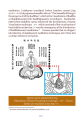
…bhūta sphere, which is located around the centre of the body where is asserted as the Middle Way51 (Pali: majjhima paṭipadā; Sanskrit: madhyamā-pratipad). This point has been identified by PhraMongkolthep…
This text examines the phrase 'the mind should be located at the center of the body while breathing in and out.' It references the teachings of PhraMongkolthepmuni regarding the center's location abov
135
Buddhist Influence on Daoist Visualization Techniques
…f Being in the presence of all the Buddhas”, which is the Visualization of Buddha or Buddhānusmṛti (Pali: Buddhañusmṛti). According to Bumbacher (2007) these Buddhist sutras influenced the development of …
This text discusses the translation of Buddhist sutras like the Pratyutpanna Samadhi-sūtra and their influence on Daoist visualization techniques. It highlights how practices such as Buddhānusmṛti and
82
…uardian spirits of the four quarters. See the Introduction to the Maha-samaya Suttanta. (Sutta - in Pali)

560
หลักฐานธรรมภายในคัมภีร์พุทธโบราณ
…orace. 1974. *Zen and zen classics*. 5 vols. Vol. IV. Tokyo: Hokuseido Press.
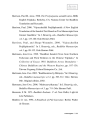
Bode, M.H. 1966. *The Pali Literature of Burma*. London: The Royal Asiatic Society of Great Britain and Ireland.
Bongard-Levin…
หนังสือเล่มนี้อธิบายและรวบรวมข้อมูลเกี่ยวกับหลักฐานธรรมภายในคัมภีร์พุทธโบราณซึ่งเผยแพร่จากงานวิจัยและบทความที่สำคัญ โดยมีการอ้างอิงแหล่งที่มาอย่างละเอียด เช่น งานศึกษาพระไตรปิฎกและวรรณกรรมปาลีในภูมิภา
565
Buddhist Manuscripts and Translations
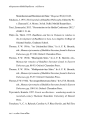
Harrison, Paul M., trans. 1998. *The Pratyutpanna samādhi sūtra,* BDK English Tripiṭaka. Berkeley, CA: Numata Center for Buddhist Translation and Research.
Harrison, Paul. 2006. "Vajracchedikā Prajñāp
This collection features key translations and studies of Buddhist manuscripts, highlighting the work of scholars like Paul M. Harrison and Jens-Uwe Hartmann. Notable texts include the Pratyutpanna sam
574
หลักฐานธรรมาภายในคัมภีร์พุทธโบราณ 1 ฉบับวิชาการ
…Honolulu: University of Hawai'i Press.
Trenkner, V., C. A. Rylands, Caroline A. F. Rhys Davids, and Pali Text
542 | Dr. ชนิดา จันทร์ศรีโสภา
งานวิจัยนี้สำรวจความสำคัญของคัมภีร์พุทธโบราณและว่ามีการพัฒนาอย่างไรในบริบทของการศึกษาพุทธศาสตร์ โดยนำเสนอคำพิสูจน์และแนวคิดจากนักวิชาการที่เคยศึกษาและทำงานในด้านนี้ รวมถึงมุมมองจากผู้ทรงคุณวุฒิในวงการ